How to backtest an iron condor on SPX, step by step
An iron condor sells a put and a call around the market and buys a cheaper put and call further out as protection. Here is one SPX iron condor backtested by hand on the real option prices of June 2024: how to set it up, what to read on each day, and how it ended.
1. Pick the day the test starts
Open the Test panel, press + New test, pick a past trading day and the cash to start with. This example starts on Monday 3 June 2024 with $100,000. SPX stood at 5,268.70 in that day's recorded prices.
2. Open the condor ticket
Press +Strat → Condor 45DTE and type SPX in the ticker box. The app solves the four legs from its starting values — short legs near 20 delta, wings near 10 delta, the expiry nearest 45 days out — and shows each leg's real bid and ask for that day. Every box can be changed; this example keeps them.
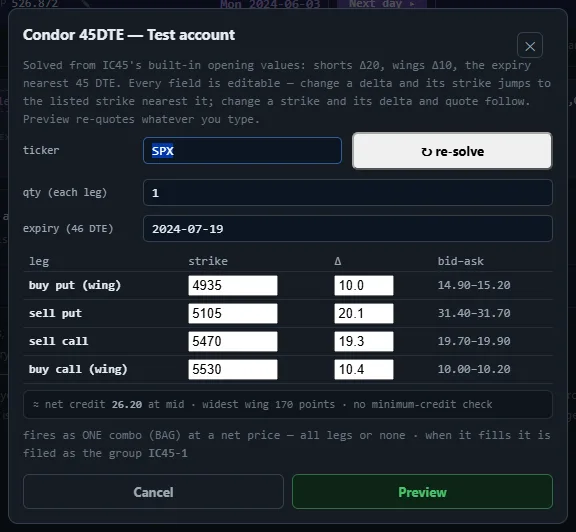
| Leg | Strike | Delta | Bid – ask |
|---|---|---|---|
| Buy put (wing) | 4,935 | 10.0 | 14.90 – 15.20 |
| Sell put | 5,105 | 20.1 | 31.40 – 31.70 |
| Sell call | 5,470 | 19.3 | 19.70 – 19.90 |
| Buy call (wing) | 5,530 | 10.4 | 10.00 – 10.20 |
3. Read the preview before it fills
Preview shows the order as one combo, the price range it will work in, and the risk: a maximum loss of $17,000 (the put side is 170 points wide; the app shows the full width, before the credit), $23,000 of margin and about $4.26 of commission. Notice the wings are not the same width — the deltas, not a fixed distance, placed them.
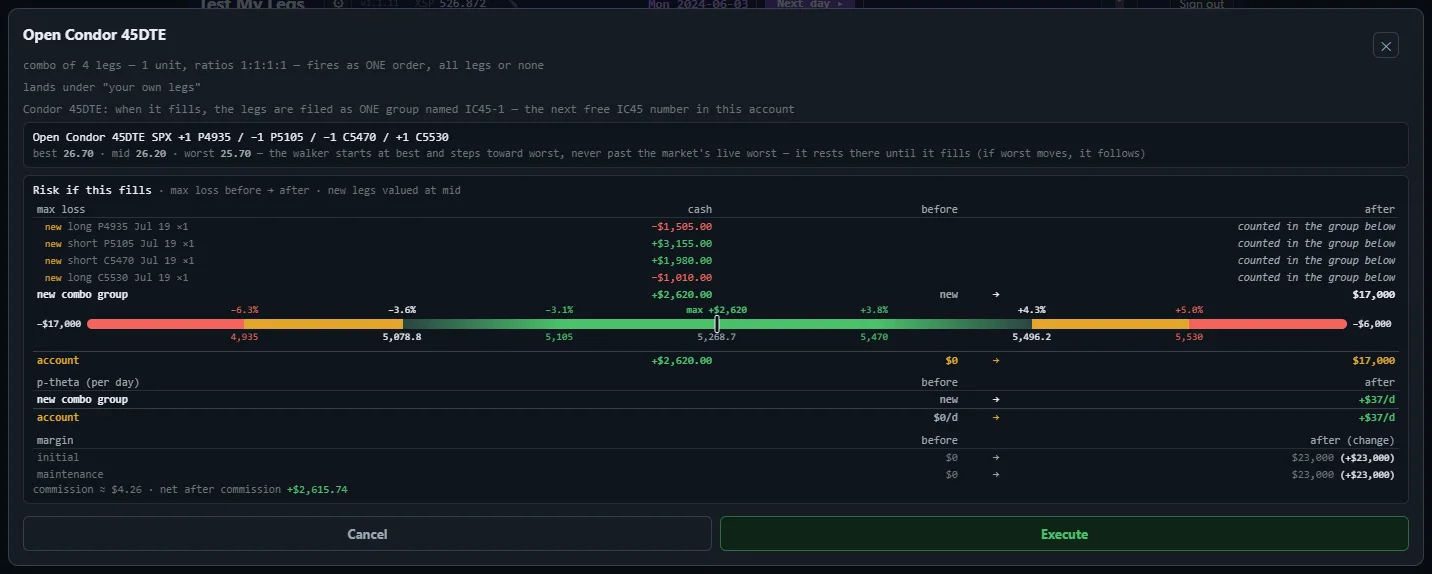
Execute filled it at the day's prices: sold the 5105 put at 31.52 and the 5470 call at 19.77, bought the 4935 put at 15.07 and the 5530 call at 10.12 — a credit of 26.10, or $2,610 for one condor. The four legs are filed together as the group IC45-1.
4. Step forward one trading day at a time
Press Next day. Every price moves to the next trading day's recorded prices, and you see the result without knowing what comes after. Here is what this condor showed:
| Day | SPX | 5470 call (short) | 5105 put (short) | Condor P&L |
|---|---|---|---|---|
| Mon 3 Jun 2024 | 5,268.70 | 19.80 | 31.55 | −$10 |
| Mon 10 Jun | 5,356.31 | 37.45 | 15.30 | +$90 |
| Mon 17 Jun | 5,482.46 | 89.90 | 6.80 | −$1,080 |
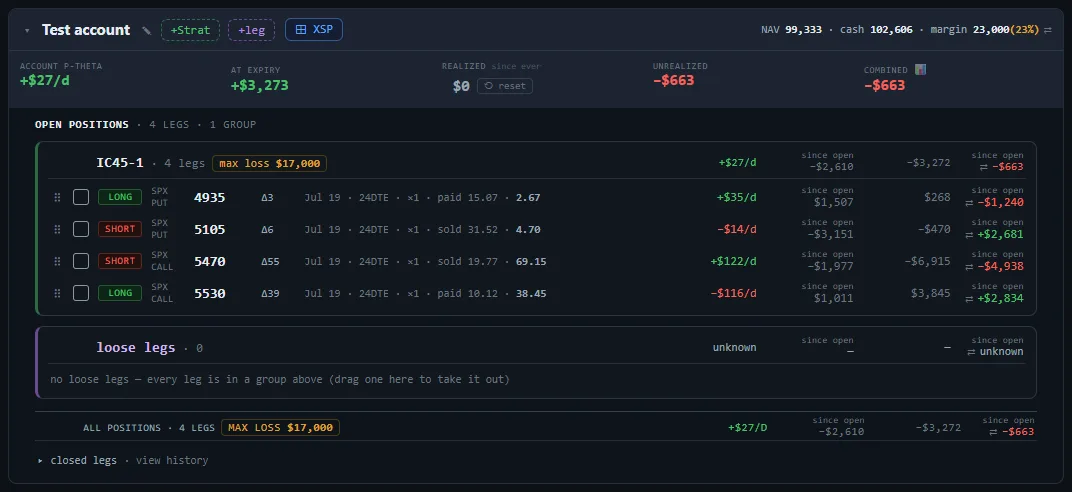
| Tue 25 Jun | 5,466.61 | 69.15 | 4.70 | −$662.50 |
SPX rose about 4% in two weeks and went past the short call. The put side lost almost all its value — good for the seller — but the call side rose faster, so the condor as a whole was down.
5. Decide: hold, roll or close
This is the part a backtest by hand is for: you decide with only what that day showed. In this example the condor was closed on 25 June 2024 (tick its legs, Close → Preview → Execute). With commissions in and out, the account ended at $99,306.49 — a loss of $693.51 on this one condor. You could just as well have rolled the call side up, or held to expiry; go back to any day you have played and try the other choice.
What this example shows
- Delta-placed wings can make one side much wider than the other, so the maximum loss is set by the wider side.
- A steady rally can hurt a condor even though the market never "crashed".
- The point of stepping day by day is to practise the decisions — not to find a rule that "always works".
This example is one real run in Test My Legs on the recorded SPX option prices of June 2024. It is a backtest: it shows what happened on those days, not what will happen next.
Try it on another date yourself. Test My Legs is free: pick a past day and step through it.
Start now